

Near Threatened
In accordance with IUCN criteria, a species is considered to be Near Threatened if it does not qualify for Critically Endangered, Endangered or Vulnerable now, but is close to qualifying for or is likely to qualify for a threatened category in the near future.
Species data
Class
Aves
Order
Accipitriformes
Family
Accipitridae
Scientific Name
Circaetus fasciolatus
Reserve locations
-
Description
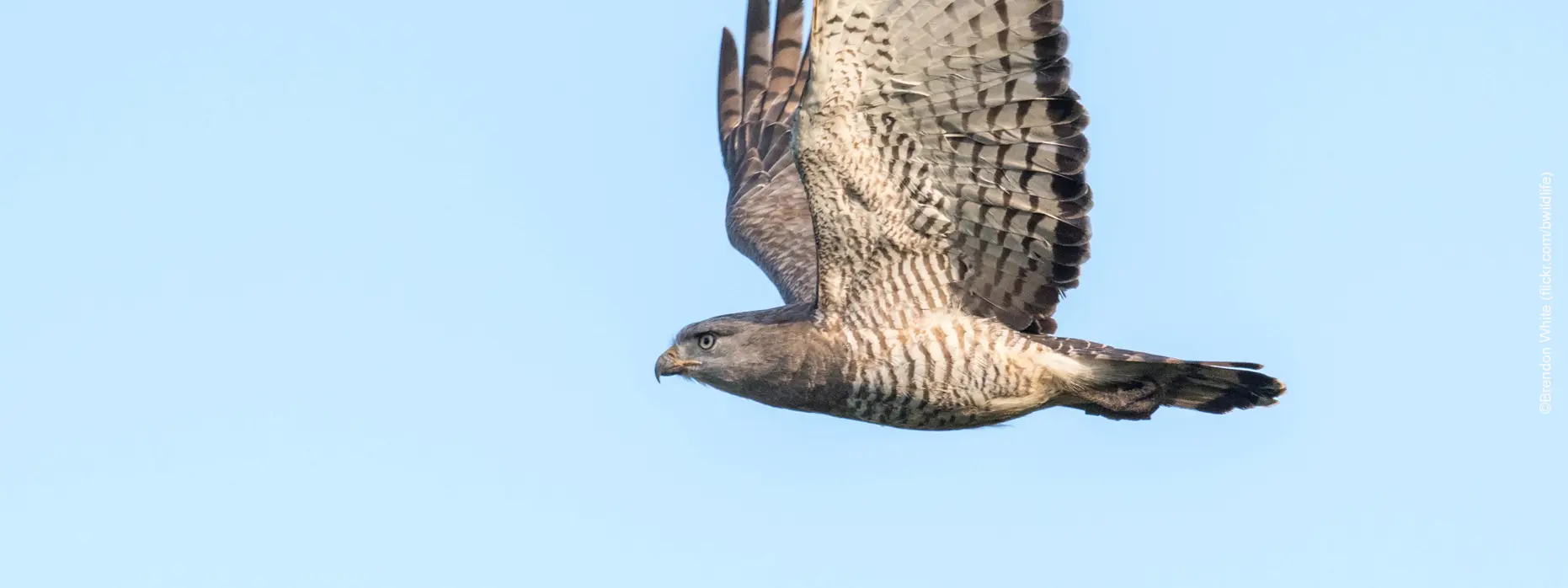
The Southern Banded Snake-Eagle is an uncommon raptor, found only along a narrow strip of the east coast of southern Africa. A small snake-eagle with a big-headed appearance, they reach 54-60 cm in length and have a wingspan ranging from 119-128 cm.
Adults are white on the underparts with a plain greyish-brown breast and brownish barring on the belly, flanks, and thighs, a greyish face, pale yellow iris, and yellow legs and cere. Their upper parts are dark brown, and in flight they show black-tipped barred flight feathers. The three white bands on the relatively long blackish tail help distinguish them from the much more common and widespread Western Banded Snake-Eagle (Circaetus cinerascens), which has just a single pale band on a shorter tail, and also has less barring on the underparts.
The juveniles differ by having white underparts with buff barring, dark brown upperparts, and a pale buff to white head with dark brown streaks.

Behaviour
Habitat
Threats and Conservation
With a global population estimated at 1,000–3,000 individuals and decreasing, the Southern-banded Snake-Eagle is listed as Near Threatened by the IUCN. In South Africa, where only 50 individuals remain, they are listed as Critically Endangered.
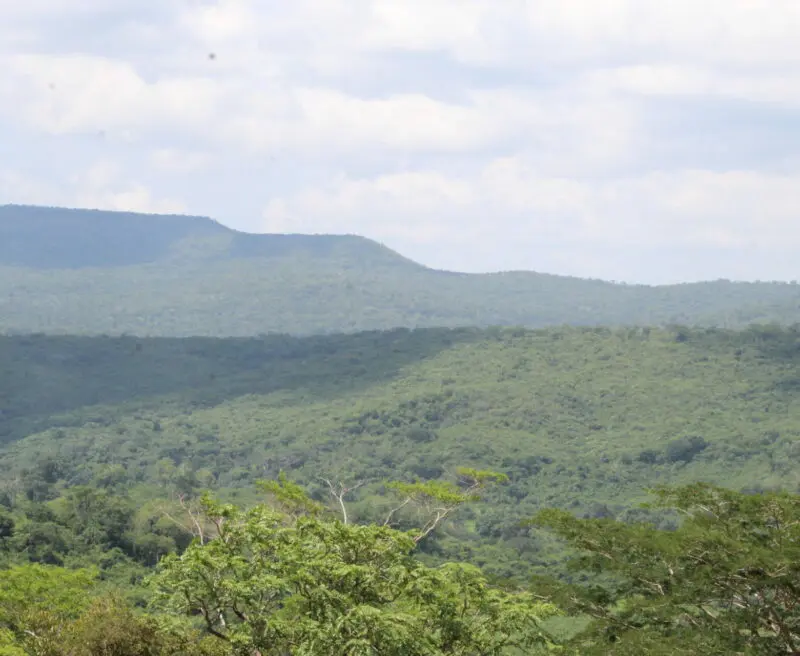
Numbers of this shy species are expected to continue to decline, and habitat loss is the chief culprit. The coastal forests they favour are threatened with deforestation, degradation, and fragmentation due to extraction of wood for timber, charcoal, poles, and firewood, as well as from slash-and-burn agriculture.
Conservation efforts include surveys to monitor the population as well as rates of deforestation and degradation, and also to increase the area of protected habitat within their range. In Tanzania and starting in 2021, WLT is supporting a project by partner TFCG to save coastal forests that are a confirmed home for the Southern Banded Snake-Eagle.