

Endangered
In accordance with IUCN criteria, a species is considered to be Endangered if it is facing a very high risk of extinction in the wild.
Species data
Class
Aves
Order
Accipitriformes
Family
Accipitridae
Scientific Name
Polemaetus bellicosus
Reserve locations
-
Description
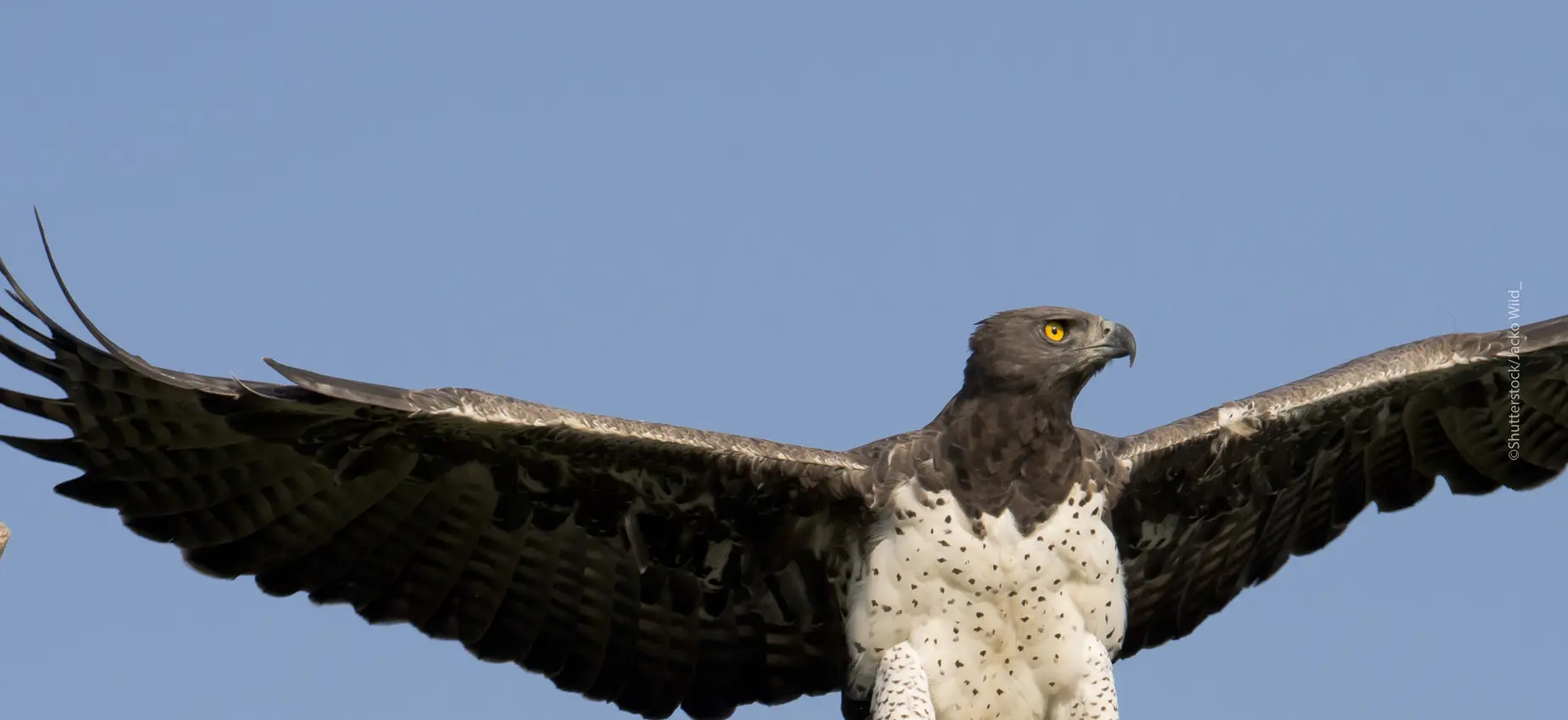
With a wingspan of over two metres and measuring 78-86 cm in length, the Martial Eagle is Africa’s largest eagle. They have a large head, stout bill, short crest, and long broad but pointed wings. Adults are brown-grey above with pale edges to the mantle, scapulars, tertials and especially the wing coverts, with a plain browner head and chest. The underparts are white and sparsely spotted dark brown on the belly, flanks and long feathered trousers. The relatively short white tail is thinly barred brownish-black. In flight, adults have dark brown underwing coverts contrasting with the brown and white barred flight feathers. Eyes are yellow and the cere and feet are pale greenish.
The sexes are similar, although females are usually more heavily spotted on the underparts, and average 10% larger than males. Juveniles are paler brown-grey above with broad whitish feather edges and speckled grey crown and hindneck, plain white below, and in flight show brown mottled white underwing coverts. The eyes are brown.

Behaviour

Habitat
Threats and Conservation
Although estimated as probably in the tens of thousands in 2001, the current global population is unknown. Observations reveal that this species has declined rapidly across much of its range since 1987, especially in unprotected areas, and continues to decline. Therefore, the Martial Eagle is categorised as Endangered on the IUCN Red List.
Shooting, trapping and poisoning by both commercial and tribal farmers, sometimes in retaliation for domestic livestock predation, are the biggest threats to this species. A decrease in natural prey may lead to increasing predation in future. Many protected areas are too small to support a breeding pair, forcing birds to forage further afield and making them more vulnerable to persecution. Other threats include habitat loss, electrocution on power lines, drowning in reservoirs, and hunting for use in traditional medicine.