


Endangered
In accordance with IUCN criteria, a species is considered to be Endangered if it is facing a very high risk of extinction in the wild.
Species data
Class
Amphibia
Order
Anura
Family
Dendrobatidae
Scientific Name
Phyllobates terribilis
Reserve locations
-
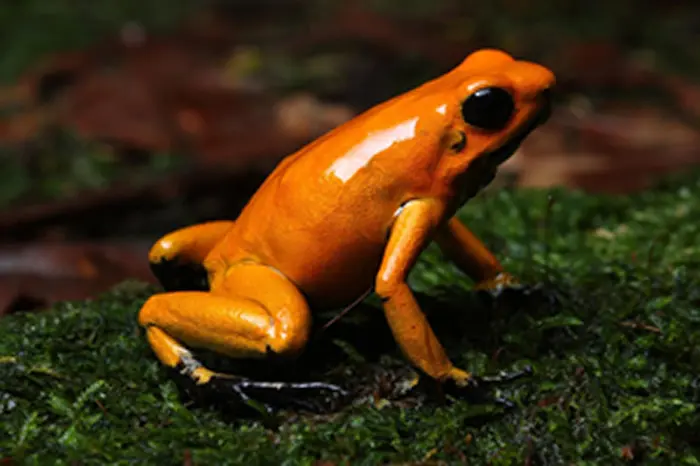
Discovered in 1973 and first scientifically described in 1978, the Golden Poison Frog is one of the largest of the poison dart frogs and it can grow to 5 centimetres. Its bright colour can vary, especially geographically, but is either golden-orange, golden-yellow or pale green.
This frog is famous for being one of the most poisonous animals in the world and a single frog carries 1,900 micrograms of poison.
The poison is so strong that it was used by Chocó Indians to poison their hunting darts, and may have once been used in warfare. The Indians would rub the tip of a dart (not an arrow) along the back of a live frog. Once dry, the poison would remain active on the dart for up to a year. The back of a single frog would provide enough poison for two or three darts; the frog was unharmed and released back into the wild. The Indians used the darts to hunt mammals and birds.
Behaviour

Habitat
Threats and Conservation
Despite being one of the most poisonous vertebrates in the world, this deadly creature remains extremely vulnerable to loss of habitat, which can come about from logging, gold mining, deforestation for agricultural development, followed by planting of crops (illegal) and pollution from crop spraying. It lives in a very restricted area and this increases its vulnerability further.
The habitat of the Golden Poison Frog was completely unprotected until 2012, when World Land Trust raised money to save its habitat with the help of corporate supporter Puro. The reserve was created in partnership with Colombian NGO, Fundación ProAves.
Today, World Land Trust’s support for a wildlife ranger in the reserve continues to play a vital role in ensuring the survival of this tiny-deadly amphibian.
Rangers funded through the Trust’s Keepers of the Wild patrol and monitor the land, preventing illegal logging and hunting.