

Endangered
In accordance with IUCN criteria, a species is considered to be Endangered if it is facing a very high risk of extinction in the wild.
Species data
Class
Aves
Order
Passeriformes
Family
Parulidae
Scientific Name
Setophaga chrysoparia
Reserve locations
Honduras
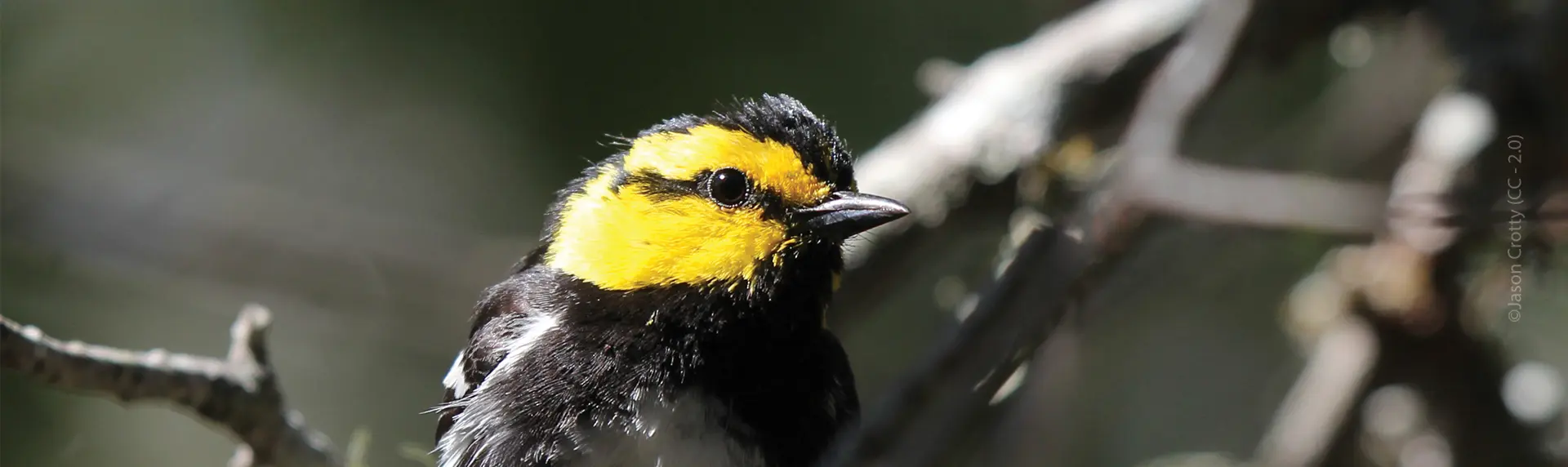
Male Golden-cheeked Warblers have a jet-black crown, throat and back, with a bright yellow face and a black line through the eye. They have two white wingbars and white underparts with black streaks down the sides. Females and juveniles are similar to males but are often paler with only a few black feathers on the throat, and an olive-green back and crown.
This migratory species typically weighs around just 10g and is between 12-13 centimetres long with a 19–21-centimetre wingspan.
The song of the Golden-cheeked Warbler includes several trills and buzzes at different pitches, including sharp chipping calls from both male and females while foraging for food. Meanwhile, the male warbler specifically emits a buzzy, hurried call when defending its territory.

Behaviour
The Golden-cheeked Warbler feeds almost entirely on insects and spiders. Common invertebrates that the species has been observed feeding on include spiders, brown and green caterpillars, green lacewings, small green cicadas, flies, moths, butterflies and other small insects. Caterpillars are a particularly important prey item during the breeding season as adults “tenderize” the caterpillars by beating them on a branch before eating or feeding to their young.
They forage actively, hunting for insects in the upper two-thirds of Junipers and deciduous trees, never descending to the ground to feed. The most common method of feeding is hopping between foliage and “gleaning” – where they pick insects from the surface of branches. Another preferred method is by “sallying” – flying out to catch the insects in midair and then returning to a perch to feed.
Typically, males establish a breeding territory of 3-6 acres in the juniper-oak woodlands of central Texas, often returning to the same site each year. The males then defend this area with song, chases, and even attacks on intruding males.
Nest building begins in early to mid-March, and eggs can be laid until mid-May. Female Golden-cheeked Warblers do the majority of work building a compact, cup-shaped nest and incubating the eggs. An essential element to building the nest is the shredding bark from juniper trees. The female may also utilise spider web, lichens, mosses, leaves, and grass. The selection of nesting habitat is especially important because nest location often affects reproductive success. Females usually lay clutches of 3 or 4 eggs each year, and both adults feed and tend to the offspring.
In its wintering grounds in Central America, the Golden-cheeked Warbler often joins mixed species flocks, which typically consist of other warbler species.

Habitat
As a migratory species, the Golden-cheeked Warbler breeds exclusively in mixed juniper-oak woodland in central Texas in the USA. It then begins its migration in late summer to spend its nonbreeding winter season in the mountainous Pine-Oak ecoregion of Central America, from southern Mexico, to Guatemala, El Salvador, Nicaragua, and Honduras.
Threats and Conservation
The Golden-cheeked Warbler is experiencing significant declines in its habitat in both its breeding and non-breeding range, and rapid population declines are being witnessed in response. Therefore, the species is categorised as Endangered on the IUCN Red List.
In its breeding grounds, nesting habitats are being cleared for land development, ranching and agriculture. Habitats are also rapidly being lost in the wintering grounds, primarily due to deforestation for expanding high-altitude agriculture, livestock grazing, fuel wood collection, forest fires and beetle infestation. All of this leads to increased habitat fragmentation and reduced connectivity across habitat patches.