

Least Concern
In accordance with IUCN criteria, a species is considered to be Least Concern if it does not qualify for Critically Endangered, Endangered, Vulnerable or Near Threatened. Widespread and abundant taxa are included in this category.
Species data
Class
Mammalia
Order
Carnivora
Family
Felidae
Scientific Name
Lynx lynx
Reserve locations
-
Description
The Eurasian Lynx is the largest of the four lynx species, generally weighing in at 18-36 kg, reaching lengths of 70-130 cm and standing 60-71 cm tall at the shoulder. All lynx can be distinguished by their long legs and large, padded paws, which are useful adaptations for travelling through snow. Other identifiers include a short tail, a thick ruff of hair framing the face, and long tufts of hair sprouting from the tips of the ears. The coat of the Eurasian Lynx varies in colour from grey or greyish brown to reddish or yellowish, occasionally unmarked but often patterned with spots or rosette markings. Six subspecies of the Eurasian Lynx have been proposed and three more require further investigation and clarification, according to the IUCN.

Behaviour
Habitat
Threats and Conservation
The Eurasian Lynx was downgraded from Near Threatened in 2002 to Least Concern in 2008, owing to its wide range and generally stable population in Europe and large parts of Asia. There are however isolated subpopulations that are either Endangered or Critically Endangered, such as the Balkan Lynx which is estimated to number just 40-50 individuals. The major threats to lynx in Europe are conflicts with hunters or livestock farmers, persecution, habitat loss and fragmentation (mainly due to infrastructure development), poor management structures and accidental mortality.
In some Asian countries, lynx face a major threat from poachers, who either hunt the cats specifically or endanger them indirectly by depleting their prey base. Lynx may also be killed by hunting dogs, accidentally caught in snares set for other animals, or killed in retaliation for taking livestock. As in Europe, habitat loss and fragmentation also occurs in Asia, but is driven additionally by logging activities and resource extraction. The lynx is a protected species across much of its range, but it continues to be hunted legally in Russia and some other countries either for sport or the fur trade.
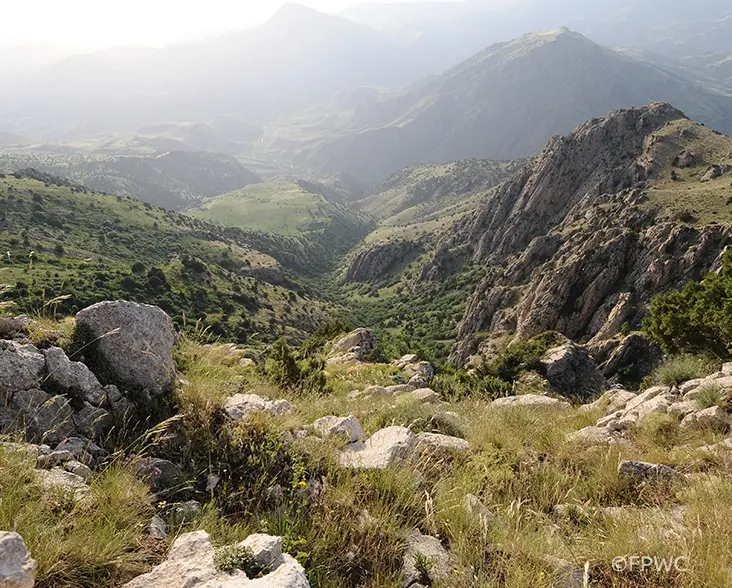
In Armenia, WLT partner FPWC manages the Caucasus Wildlife Refuge, providing over 30,000 ha of protected habitat for the Eurasian Lynx, Grey Wolf, Caucasian Leopard and Syrian Brown Bear, as well as prey species like the Armenian Mouflon and Bezoar Goat. The mountainous steppe, grasslands and Juniper forests here provide ample hunting and foraging grounds, while FPWC rangers patrol for poachers and engage with local communities to reduce human-wildlife conflict. A new project led by WLT and FPWC aims to plant 700,000 native trees here between 2023 and 2027, restoring 300 ha of degraded habitat along a migratory route for these large mammals.