

Least Concern
In accordance with IUCN criteria, a species is considered to be Least Concern if it does not qualify for Critically Endangered, Endangered, Vulnerable or Near Threatened. Widespread and abundant taxa are included in this category.
Species data
Class
Mammalia
Order
Carnivora
Family
Viverridae
Scientific Name
Civettictis civetta
Reserve locations
Zambia
Description
The African civet is one of the largest members of the mammal family known as viverrids, with mature adults weighing up to 20 kg.
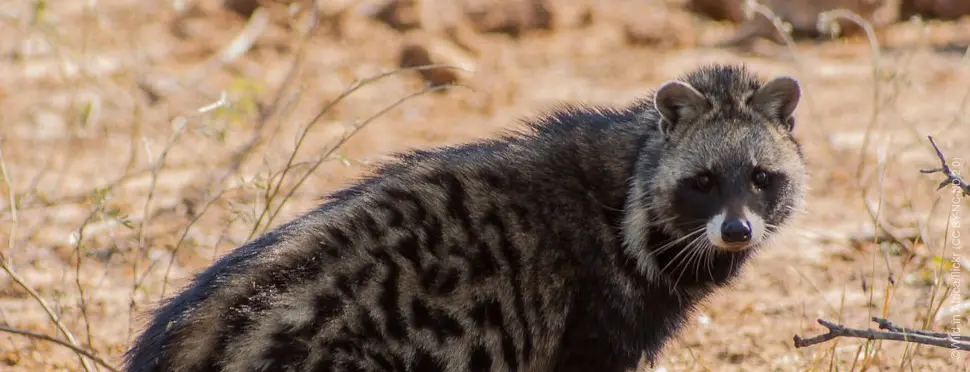
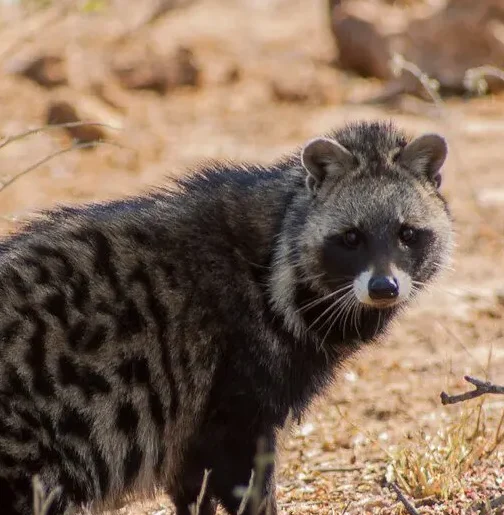
Resembling a racoon, the civet has a long neck, pointed snout and a wide head with small eyes and rounded ears1.
The coat is coarse and wiry with a steady transition of colour from a yellowy brown on the back down to a white underside. They have distinctive white neck stripes and black spots along the shoulders that smear into lines over the back legs. A short mohawk-like stripe of black hair runs all the way down the spine, from the head down to the tip of the tail and stands on end when the civet is excited or scared.
Behaviour
An elusive species, the African civet is solitary, except when mating, and is predominantly nocturnal.
They produce several different vocalisations including screams, growls and a characteristic “ha ha ha” sound that is used to make contact with other civets. They are territorial animals and have large perineal glands that release a strongly scented substance called civetone which they use to mark their territory.
As an opportunistic omnivore, the African civet feeds upon a wide range of species such as invertebrates, rodents, reptiles, fruits and other vegetation.
Habitat
Native to sub-Saharan Africa, the African Civet’s range is widespread and the species can be found in over 35 countries.
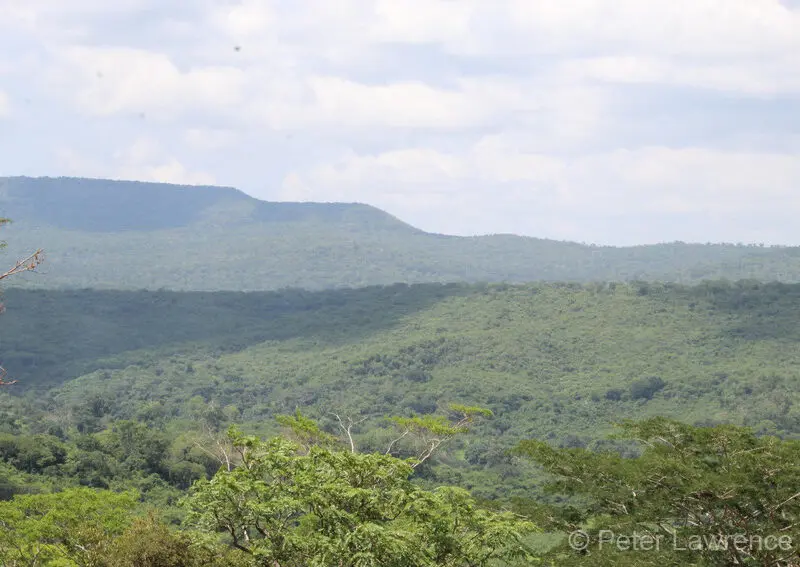
They occupy a wide range of habitat types such as forest, savanna, shrubland and wetlands and are regularly spotted near human occupied areas such as villages and farms.
Threats and Conservation
Because of its wide distribution and presence in numerous protected areas, the African civet is currently classed as ‘Least concern’ by the IUCN Red List. However, due their secretive lifestyles, population numbers are unknown, and it is thought that they may be experiencing some localised declines through hunting for bushmeat.
Individuals are often caught and placed into captivity for the production of civetone which is used as a basic ingredient for many perfumes.
Starting in 2021 and with support from WLT, Tanzanian conservation body TFCG will create 10 reserves to protect a stretch of coastal forests in the Lindi District, southeastern Tanzania, that is a known home of African Civet.